Traditional, conservative, Christian: how supposedly old values emerged in the official and media discourse in Russia since 2012
russia
A data-driven exploration of how references to different types of values evolved in official statements and the media in Russia in the last two decades.
 Context
“Traditional values” have emerged in Russia’s public discourse with new vigour starting with 2011-2012 (see e.g. Quenoy and Dubrovskiy 2018, 94.) and have soon become prevalent in Russian official and public discourse. With Putin’s return to the presidency in 2012, conservatism has become “official state posture” (Laruelle 2016, 287) in Russia. Increased reliance on conservative ideology may have been conceived largely instrumentally (Rodkiewicz and Rogoża 2015), as a discursive turn useful to reconsolidate after the wave of protests of 2011-2012 (Sharafutdinova 2014), but in the following years it has solidified as a central component of the Kremlin’s narrative about Russia itself, as well as its contrapposition with the West. These values have been called “traditional”, “conservative”, “Christian” - all expressions which would suggest they may not be specifically Russian. And yet, they were also unique, something that made Russia a “distinct civilisation” (Tsygankov 2016).
Well before Russia’s fulls scale invasion of Ukraine in 2022, “spiritual-moral values” became an issue of national security in Russia, and a form of defence against foreign threats and influence (Østbø 2017). Indeed, “traditional Russian spiritual-moral values” (“традиционные российские духовно-нравственные ценности”) explicitly and repeatedly featured in the national security strategy of the Russian Federation introduced in 2015 (and then again in the more recent strategy introduced in 2021), in contrast to previous versions of the same document President of the Russian Federation (2021). “Traditional spiritual-moral values” are mentioned 10 times in the Foreign Policy Concept of the Russian Federation approved on 31 March 2023 (President of the Russian Federation 2023).
In 2022, they arguably became an important part of the rhetoric repertoir used to legitimise Russia’s military actions, and have become even more clearly “a focal point in the domestic crackdown on the liberal opposition, and in the standoff between Russia and the West in international affairs” (Østbø 2017, 202).
In this post, I will explore references to “values” in Russian official discourse and media in Russia. More specifically, I will:
identify which qualifiers have most commonly been added to “values” in the last two decades
check the relative frequency of various expressions used to refer to these values (e.g. traditional VS conservative VS Christian), and how they have evolved
check if indeed references to “traditional values” (or similar expressions) has increased in 2012 compared to previous years
check if there is a change in connection to Russia’s invasion of Ukraine and in more recent months.
As will become apparent, some of the data sources used in this document have some features that make it more difficut to conduct consistent longitudinal analyses. Such limitations will be outlined clearly, as they are likely to have substantive impact on the results; they include issues of data availability, change in the volume of text available, and the same expressions used in different contexts (e.g. Western values were positive in the early 2000s, but negative in the early 2020s). Indeed, in this respect this post serves also as an exploration of the many challenges that come with longitudinal data analysis of textual corprora generated from online sources.
The unit of analysis
Throughout this post, the main unit of analysis will be the sentence. As will become soon apparent, qualifiers that clarify which “values” are being talked about often do not come immediately before or after the word “values” itself, but are part of longer expressions. Also, quite often more than qualifier is included (e.g. “spiritual-moral values”); some analyses will consider all qualifiers found within the same sentence, while others, for comparison, will just consider the qualifier that immediately precedes the word “values”. In such cases, the unit of analysis will only be mentions of “values” preceded by a relevant qualifier (full list below).
How frequent are references to “values”?
Let’s start with the English-language version of the Kremlin’s website, which should give some context, and then switch to a wider range of sources which are available only in Russian.
English-language version of Kremlin.ru has 32 102 items in total published between 31 December 1999 and 27 February 2023. If we count sentences, rather than items published, we have 821 552 sentences in total in our corpus. Among them, 2 120 make reference to “values”.1
Let’s look at their distribution.
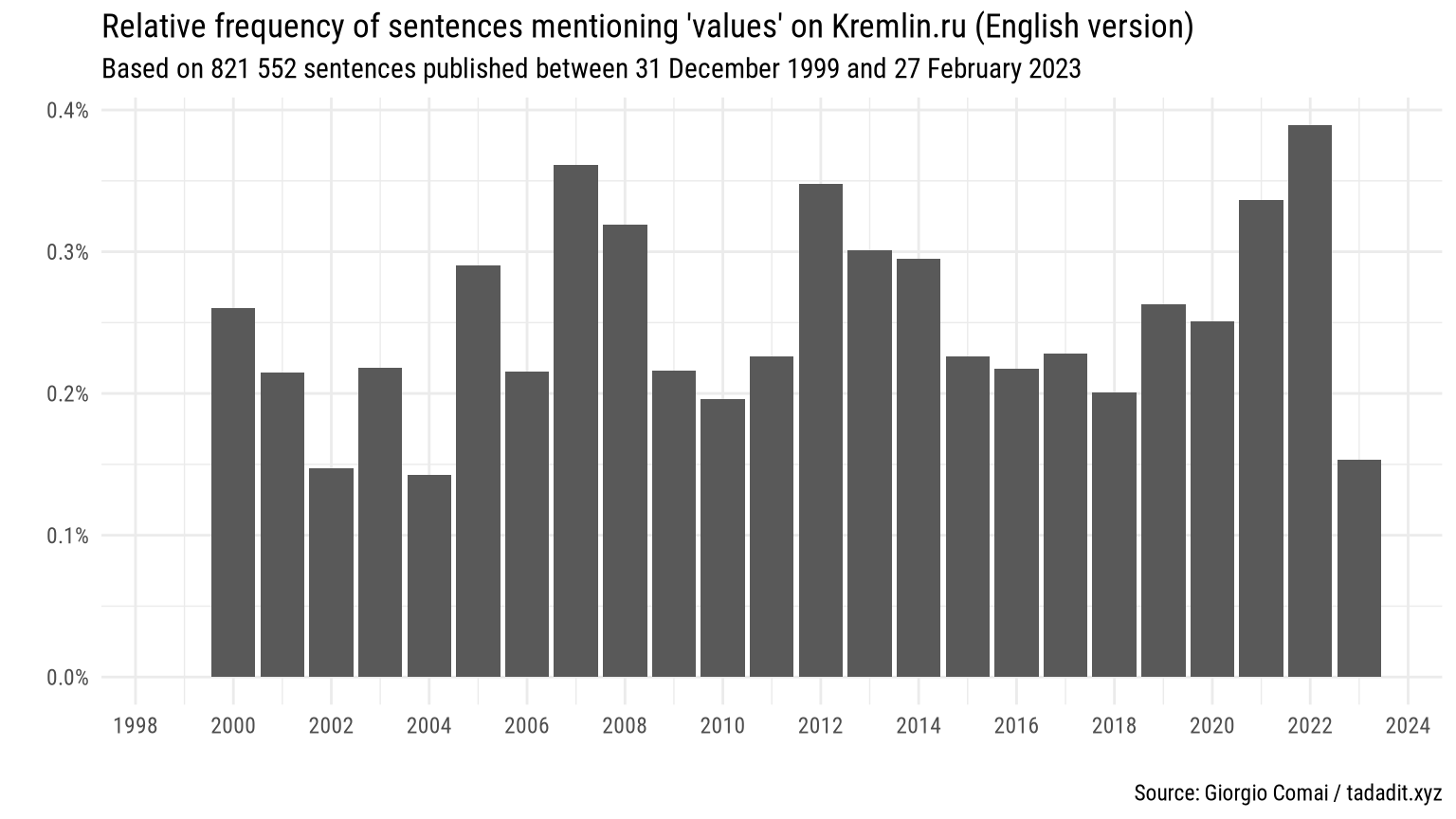
While there is an increase in the absolute number of references to “values”, this is overall balanced out once we account for the increasing number of text published by the Kremlin each year.
See the data in both relative and absolute formats looking at the tabs.
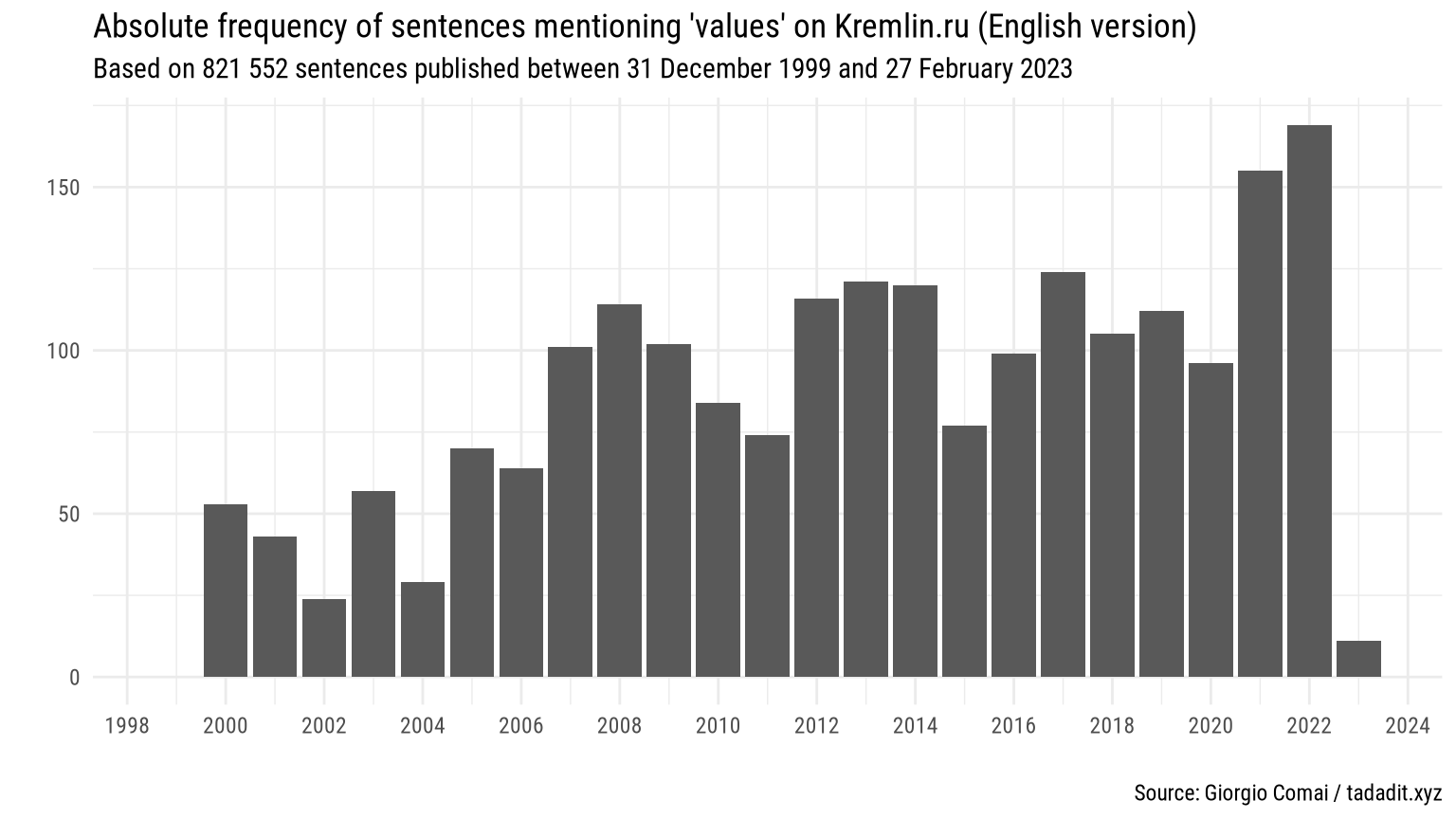
| year | all | with_values | without values |
|---|---|---|---|
| 1999 | 171 | 0 | 171 |
| 2000 | 20 389 | 53 | 20 336 |
| 2001 | 20 016 | 43 | 19 973 |
| 2002 | 16 297 | 24 | 16 273 |
| 2003 | 26 149 | 57 | 26 092 |
| 2004 | 20 302 | 29 | 20 273 |
| 2005 | 24 106 | 70 | 24 036 |
| 2006 | 29 716 | 64 | 29 652 |
| 2007 | 27 960 | 101 | 27 859 |
| 2008 | 35 718 | 114 | 35 604 |
| 2009 | 47 206 | 102 | 47 104 |
| 2010 | 42 810 | 84 | 42 726 |
| 2011 | 32 692 | 74 | 32 618 |
| 2012 | 33 350 | 116 | 33 234 |
| 2013 | 40 217 | 121 | 40 096 |
| 2014 | 40 716 | 120 | 40 596 |
| 2015 | 34 024 | 77 | 33 947 |
| 2016 | 45 543 | 99 | 45 444 |
| 2017 | 54 373 | 124 | 54 249 |
| 2018 | 52 254 | 105 | 52 149 |
| 2019 | 42 643 | 112 | 42 531 |
| 2020 | 38 301 | 96 | 38 205 |
| 2021 | 46 024 | 155 | 45 869 |
| 2022 | 43 405 | 169 | 43 236 |
| 2023 | 7 170 | 11 | 7 159 |
An argument could possibly be made that the increased number of publications on the Kremlin’s website reflects the fact that it has become more common to cover minor events, but that the overall number of “big speeches” where one would talk about values has effectively remained constant, and hence the absolute figures are what really matters. But even looking at absolute numbers, we can see that the “moral turn” that according to the literature has started in 2012 is not really reflected in a sudden spike of references to “values” in the presidential rhetoric. Indeed, even if the figure for 2012 is much higher than that for the last year of Medvedev’s presidency in 2011, it is very much comparable to the the number of mentions recorded in 2007 and 2008. If we focus on absolute numbers, only beginning with 2021 there is an effective increase in comparison with 2007-2008.2 If instead we focus on relative numbers, we’ll notice 2007, 2012, and 2022 as somewhat exceptional years, when about 0.4 per cent of all sentences included a reference to “values”.
Ultimately, however, it is not the number of references to “values” per se that is most relevant: what type of values have been talked about at different points in time may be more revealing.
First, what “values” are we talking about?
There are many different types of “values” that appear in the Kremlin’s statements. Here is a rather comprehensive list of the most common qualifiers or expressions used to characterise the values. They are categorised and colour-coded in order to make it easier to spot them in the quotes below. The categories are indicative and may be adjusted (suggestions welcome).
Different types of values in the Kremlin’s official statements
I will now proceed to different ways of looking at these data. First, here are all references to values found in transcripts, statements, and press releases published on the Kremlin’s website between 31 December 1999 and 27 February 2023. Look at both tabs to see the quotes in either English or Russian.
For easier reference, keywords such as “values”, and different types of values are highlighted and colour-coded - traditional, Western, universal, common, and negative.
As will be immediately evident, different types of qualifiers can be present in the same sentence. Some of them are very generic; for example, talk of common values is common when meeting foreign delegations, no matter the country involved (“based on our common values…”). In a few instances, they are not even used as qualifiers to values, but in the overwhelming majority of cases there is a clear connection.
I will now proceed to count the frequency of different types of “values” at different point in times. The reader is however advised to have a quick look in the table above at some of the references in the early years as well as to those in recent months. Even if references to “spiritual values” are present in both, I would argue that a change in tone is evident to the human reader. This, of course, will not emerge from the numbers.
For example, on 11 June 2000, president Putin made reference to Russia within:
“the unity of Europe on the basis of common values of progress, democracy and freedom” (source)
Reference to the values of democracy and freedom, are quite different in recent documents. For example, in a 21 February 2023 Presidential Address to the Federal Assembly, president Putin made reference to freedom and democracy along with “values”, but this is made with scorn with reference to the West:
“They can also continue to rob everyone under the guise of democracy and freedoms, to impose neoliberal and essentially totalitarian values…” (source)
Both of these quotes are counted as intances of “values” associated with multiple “Western” qualifiers.
Counting different types of values by the Kremlin
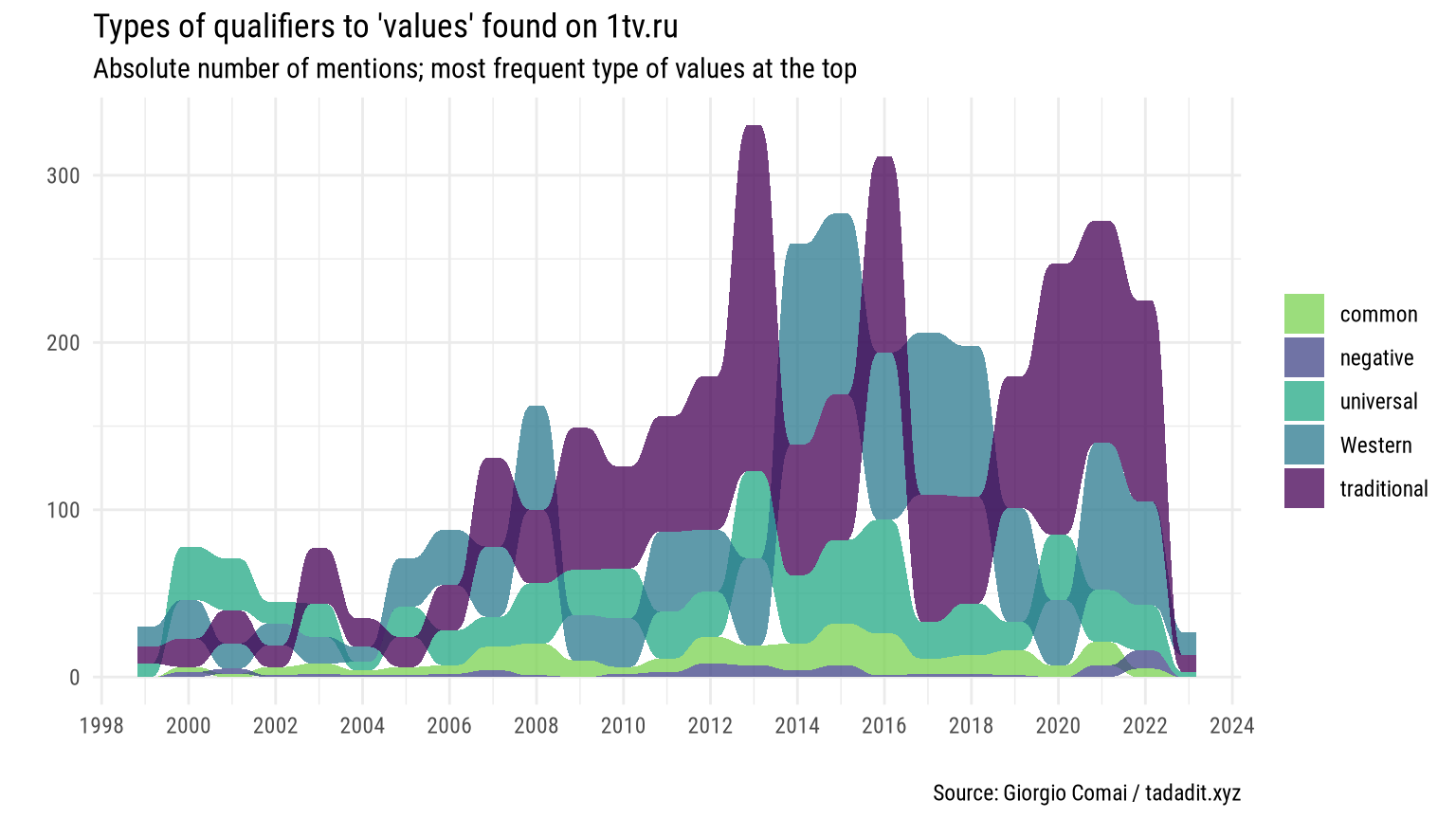
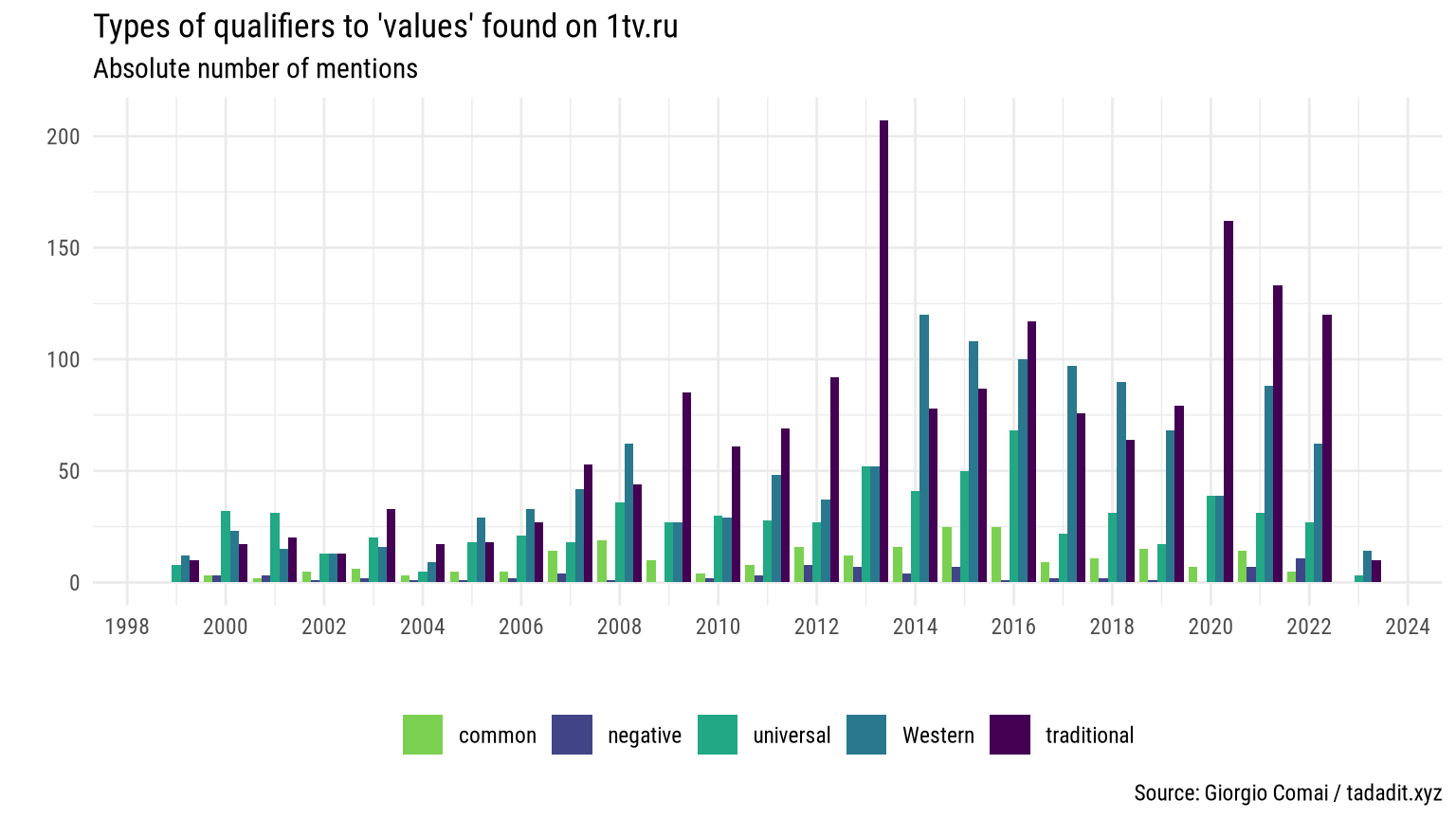
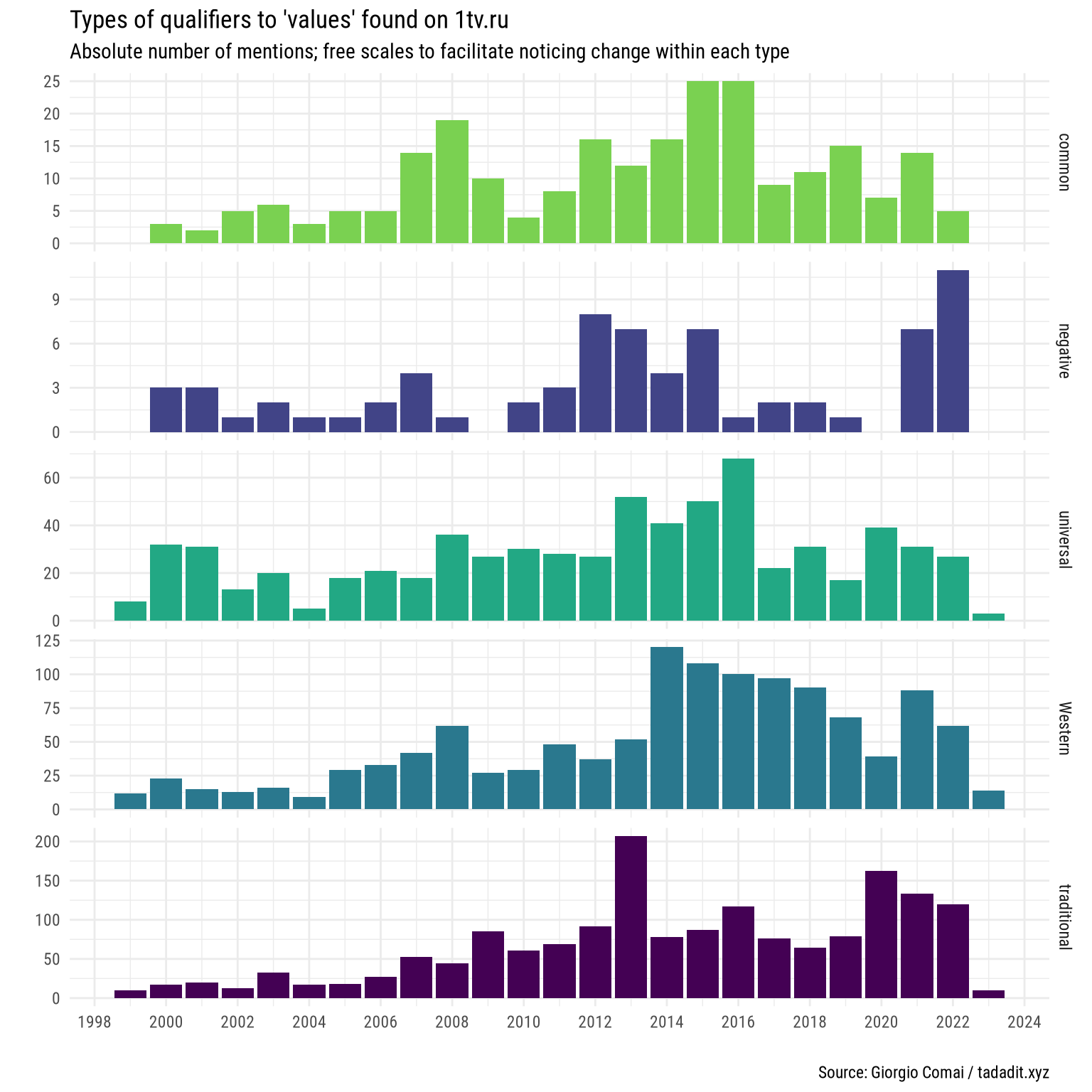
Here are a few ways to look at these data visually. The first type of plot allows to see both absolute number and ranking of the most common types of “values” found in this dataset. Looking at the graph with “Most frequent at the bottom”, it appears clearly how “traditional values” became the most common type of values since the mid-2000s, but also how the number of mentions has substantially increased in the following years. Switching to “Most frequent on the top” it emerges more clearly how the number of references to other types of values, taken together, have not really decreased… the total number has gone up due to increased references to “traditional values”. Finally, the faceted barchart allows to see better the developments within each category. For example, it appears more clearly how references to “Western values” have decreased even in absolute numbers (and in spite of the fact, which does emerge from this graph, that early mentions were almost exclusively positive, while many more of the recent mentions are effectively negative in sentiment); indeed, “Western values” were the type most commonly mentioned in both 2003 and 2004.
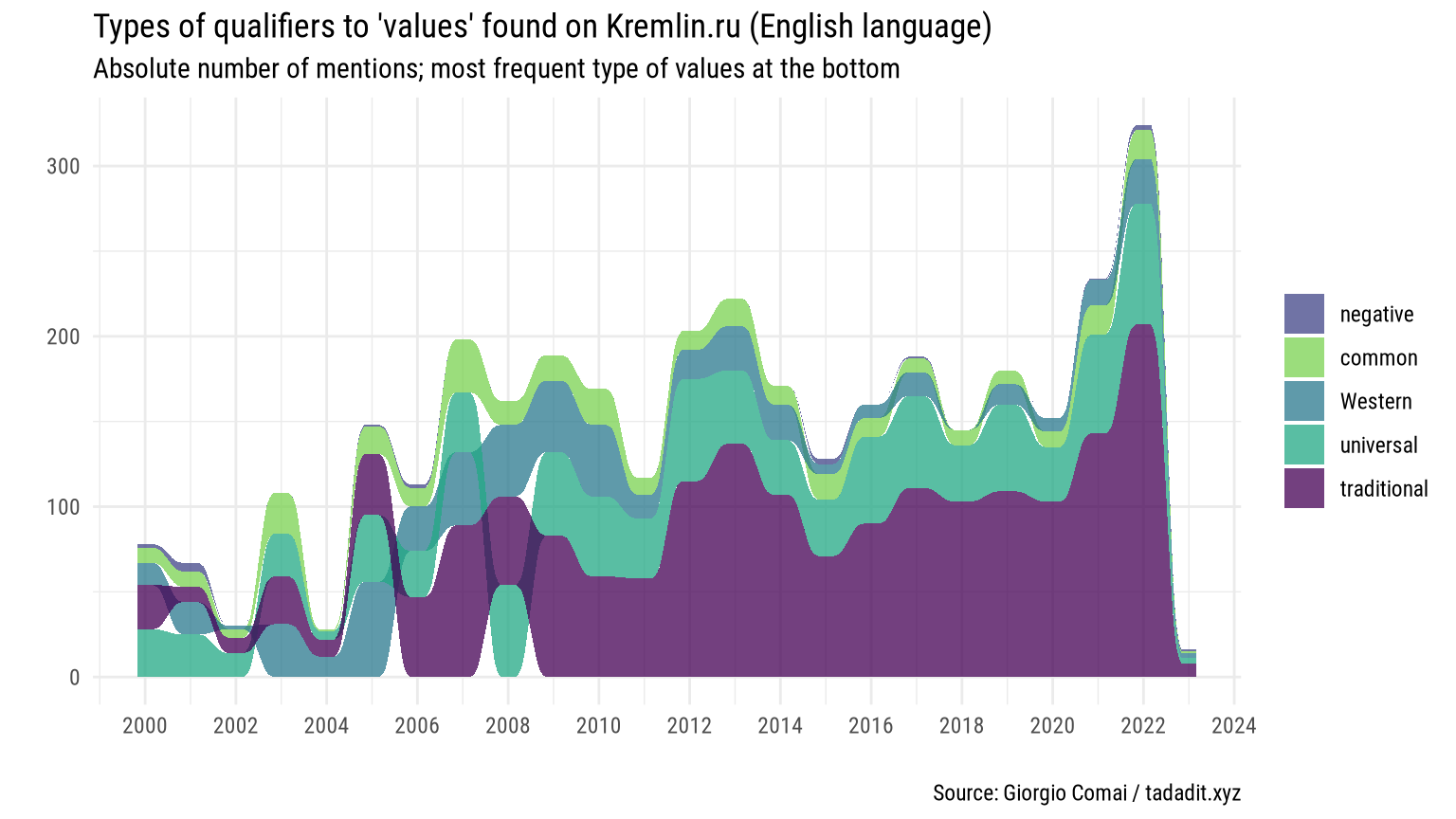
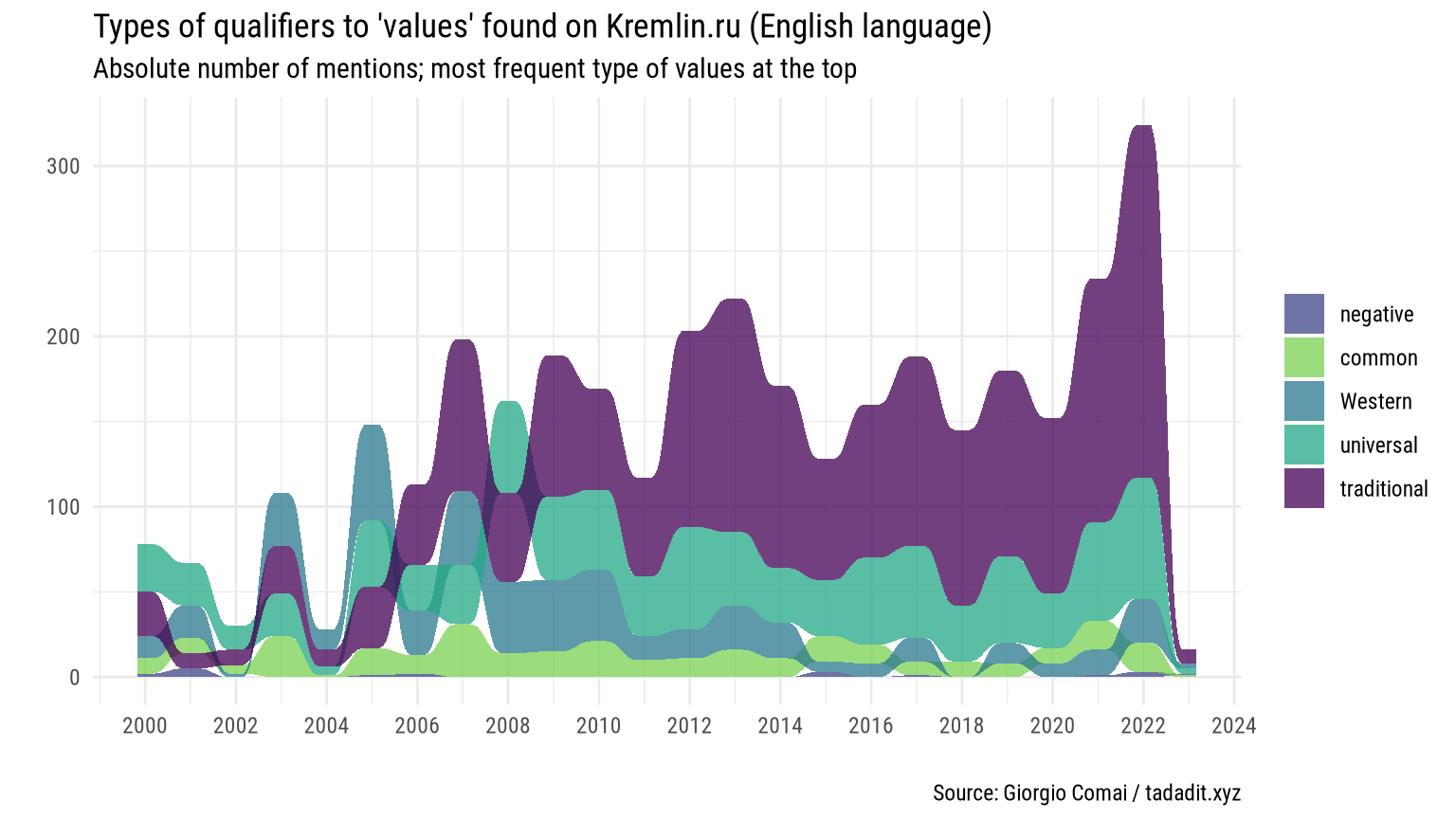
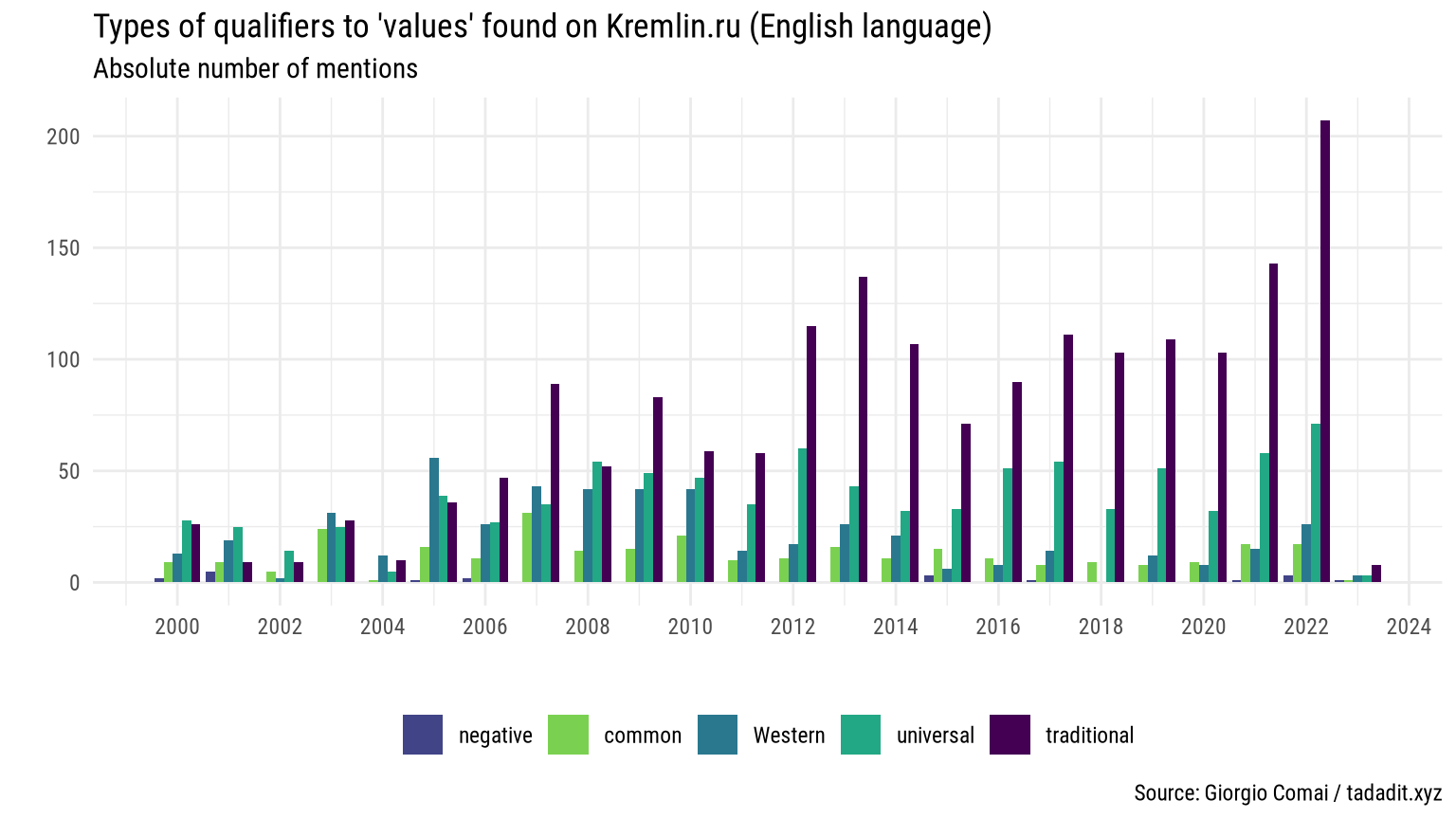
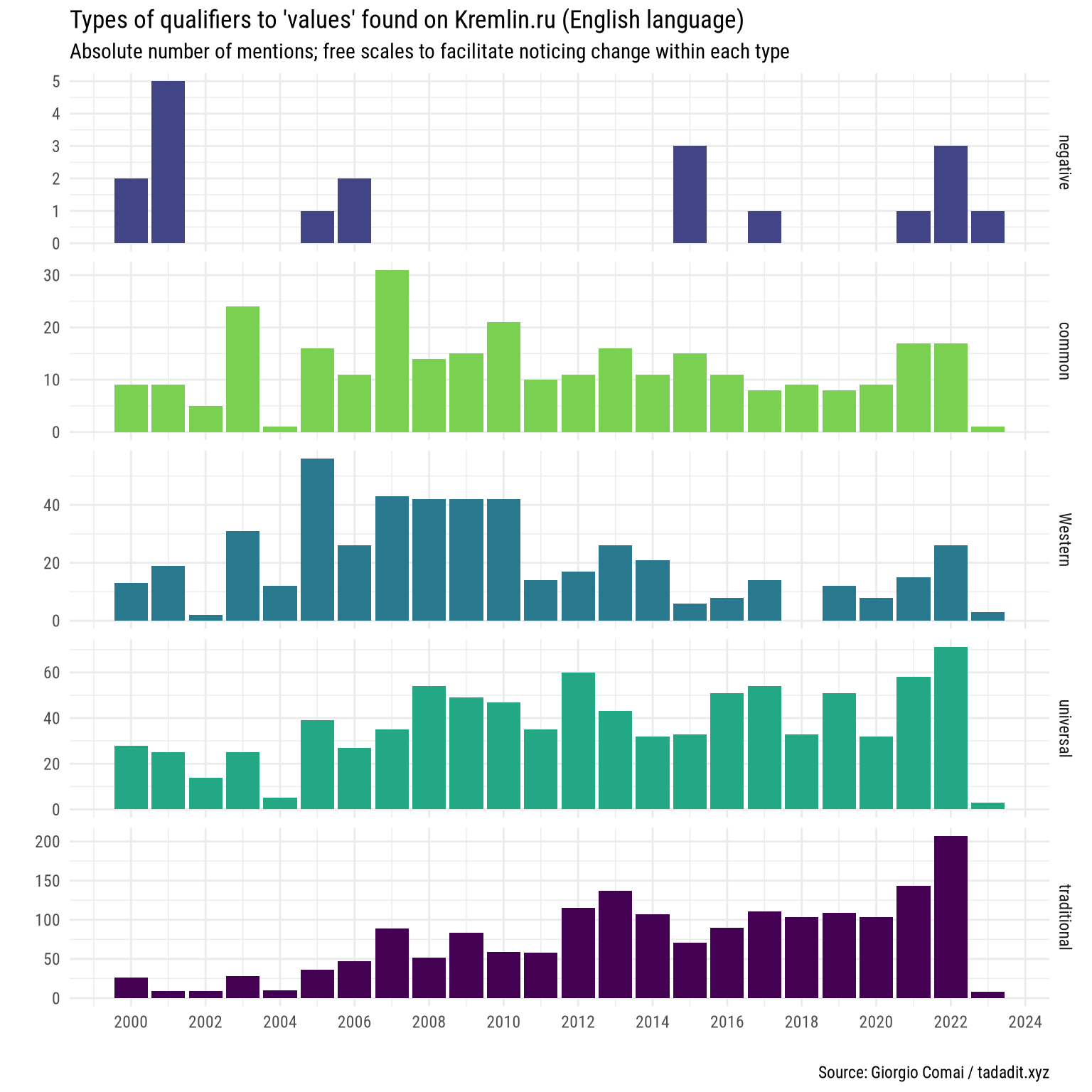
All of these graphs are in absolute, not relative number of mentions, which means that showed values are impacted by both the increased number of publications and the increased number of references to “values”.
Here are two alternative ways to look at these data.
First, let’s show the relative frequency of each type of qualifier, out of all qualifiers found in the same sentence as “values”.
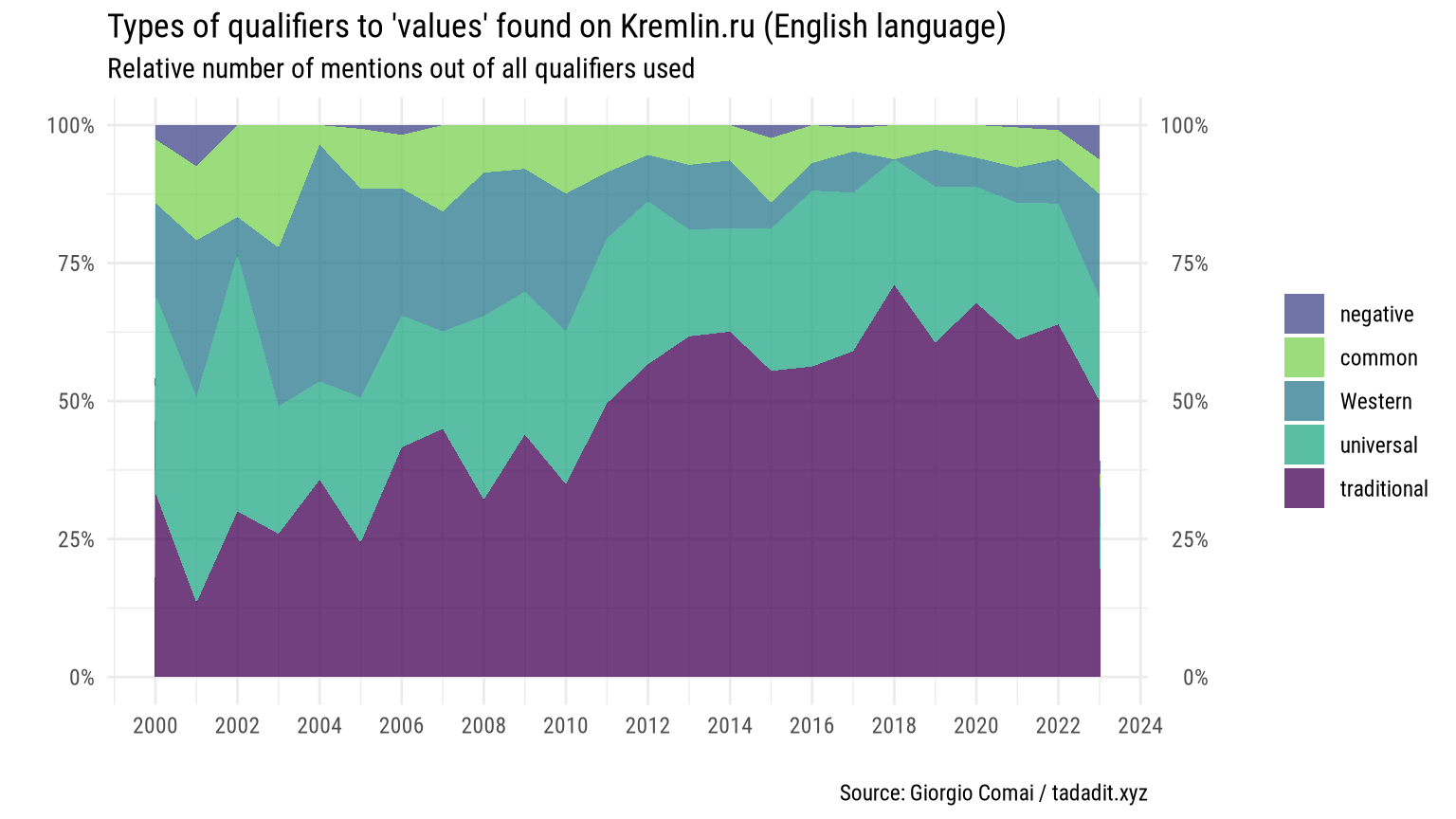
This shows a more clearly the increase in qualifiers of the “traditional” type. Considering that, as shown above, more than one qualifier can be attributed to a single reference to “values”, this can partly be attributed to the increased frequency of multiple qualifiers associated with traditional values: in a sentence such as “traditional spiritual, moral and family values”, the current method counts four instances of qualifiers of the traditional type.
An additional approach is to look specifically at the last word before “values”, and drop further context. In this case, each instance of value can be associated with either one or zero categories (if the word preceding “values” is not in the list).
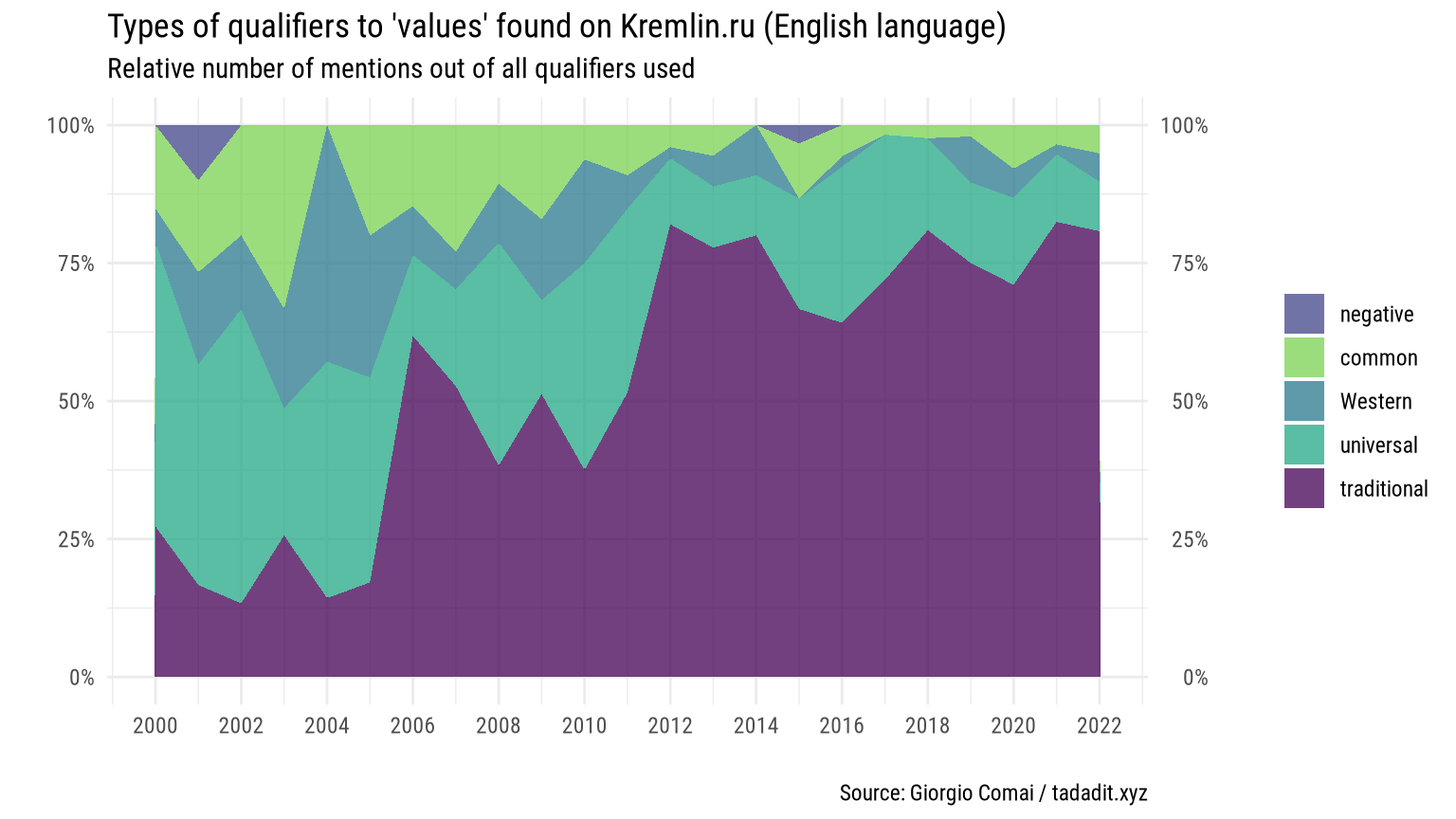
This shows even more clearly the increase in references to traditional values. Among all references to values, only about 20 per cent were references to traditional values in the early 2000s. This grew to about 75% starting with 2012.
Looking specifically at traditional values
Finally, as we are specifically looking at “traditional values”, we will be separately singling out a variety of expressions used to refer to such values to make sure we are only capturing expressions that are very clearly identifiable as “traditional values”. Here is a table with the most common expressions used:
How has the use of these specific expressions evolved through time?
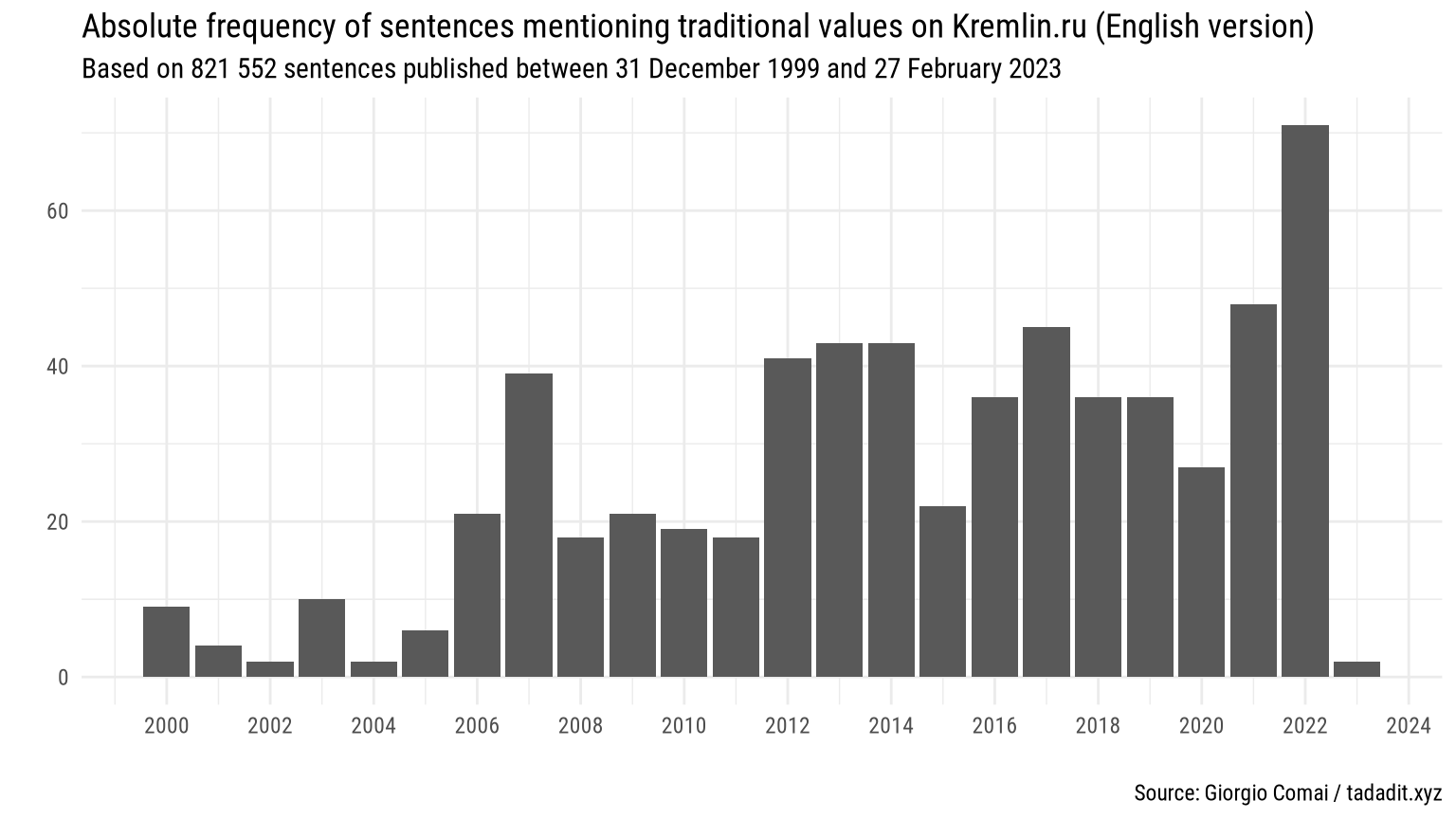
Here is a graph showing the absolute number of mentions.
Here is a graph showing the relative number of mentions of the specific list of expressions associated with traditional values listed above, compared with all other references to “values”.
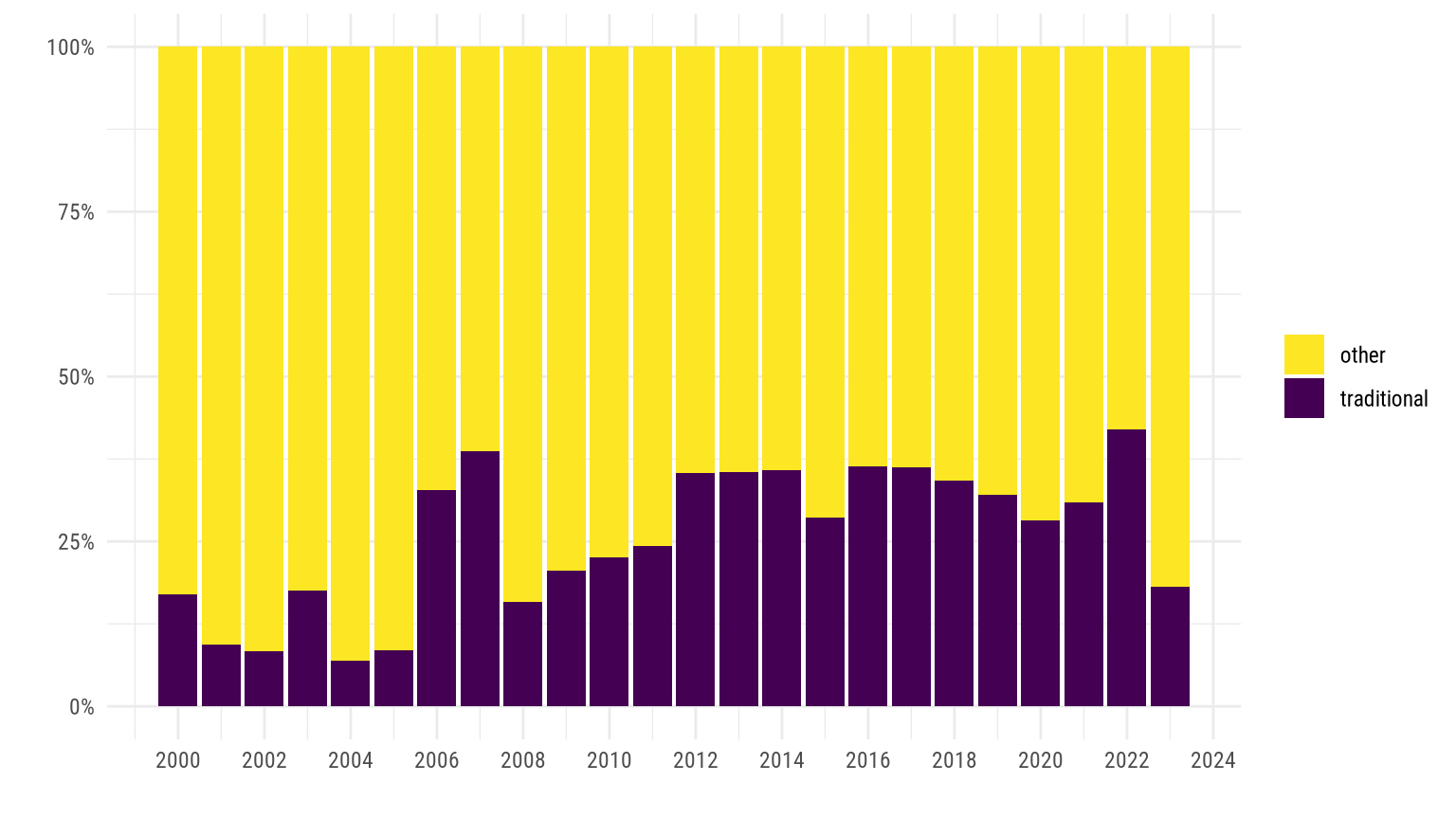
It appears that indeed references to such expressions characterising traditional values were little used in the early 2000s; even if they did not fully enter the Kremlin’s vocabulary in the Medvedev years, thay have been used rather frequently both in 2006 and 2007, and then more consistently (and in line with expectations stemming from the literature) starting with 2012, after Putin’s return to the presidency, with the partial exceptions of 2015 and 2020 (in the latter case, perhaps due to more restrained public discourse in the context of the Covid pandemic). Finally, in 2022, references to “traditional values” increased very significantly in absolute terms, and quite noticeably in relative terms compared to other expressions referring to values (in a context in which total number of references to “values” has anyway been increasing).
What about mainstream media?
Pervy Kanal
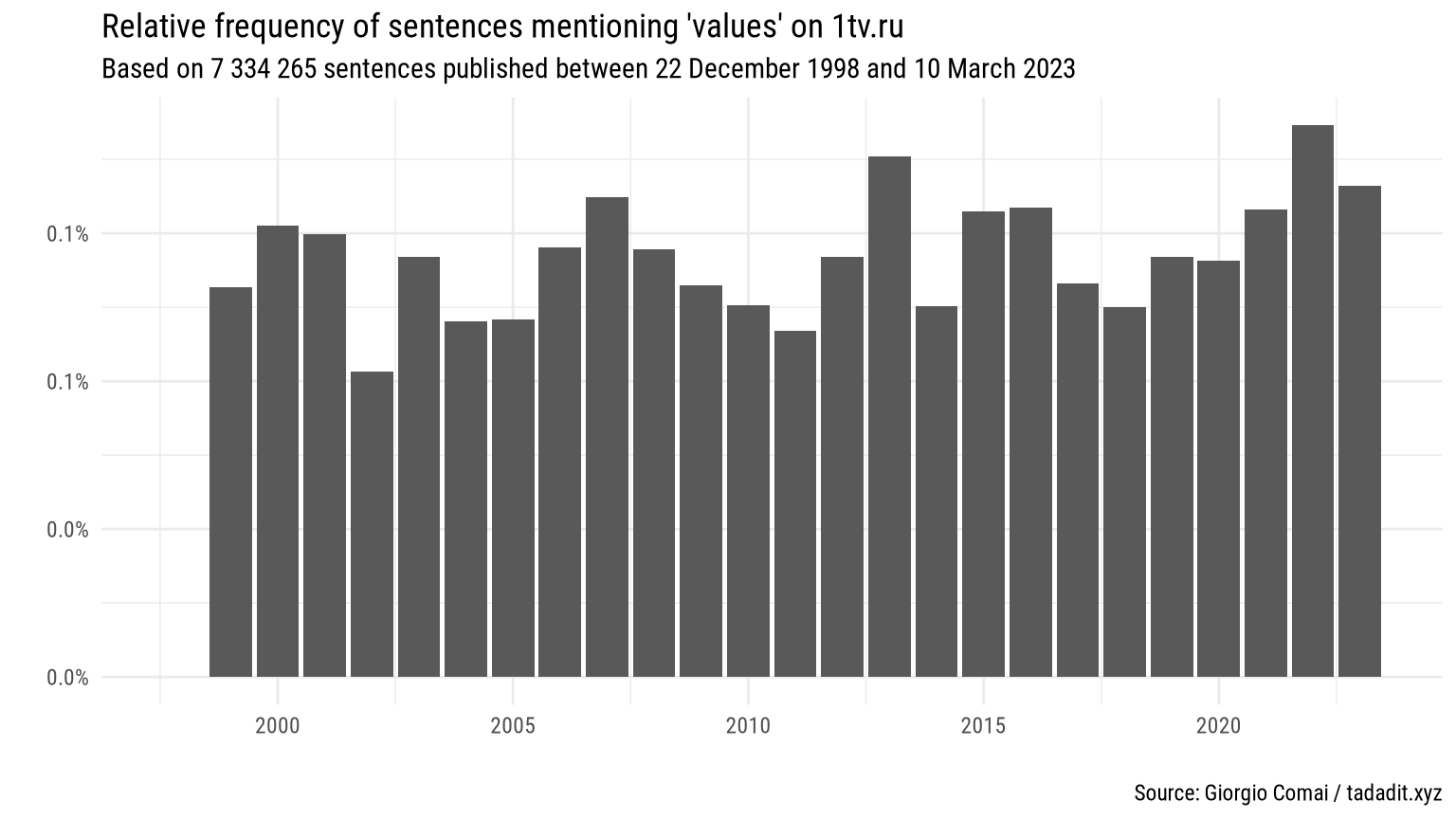
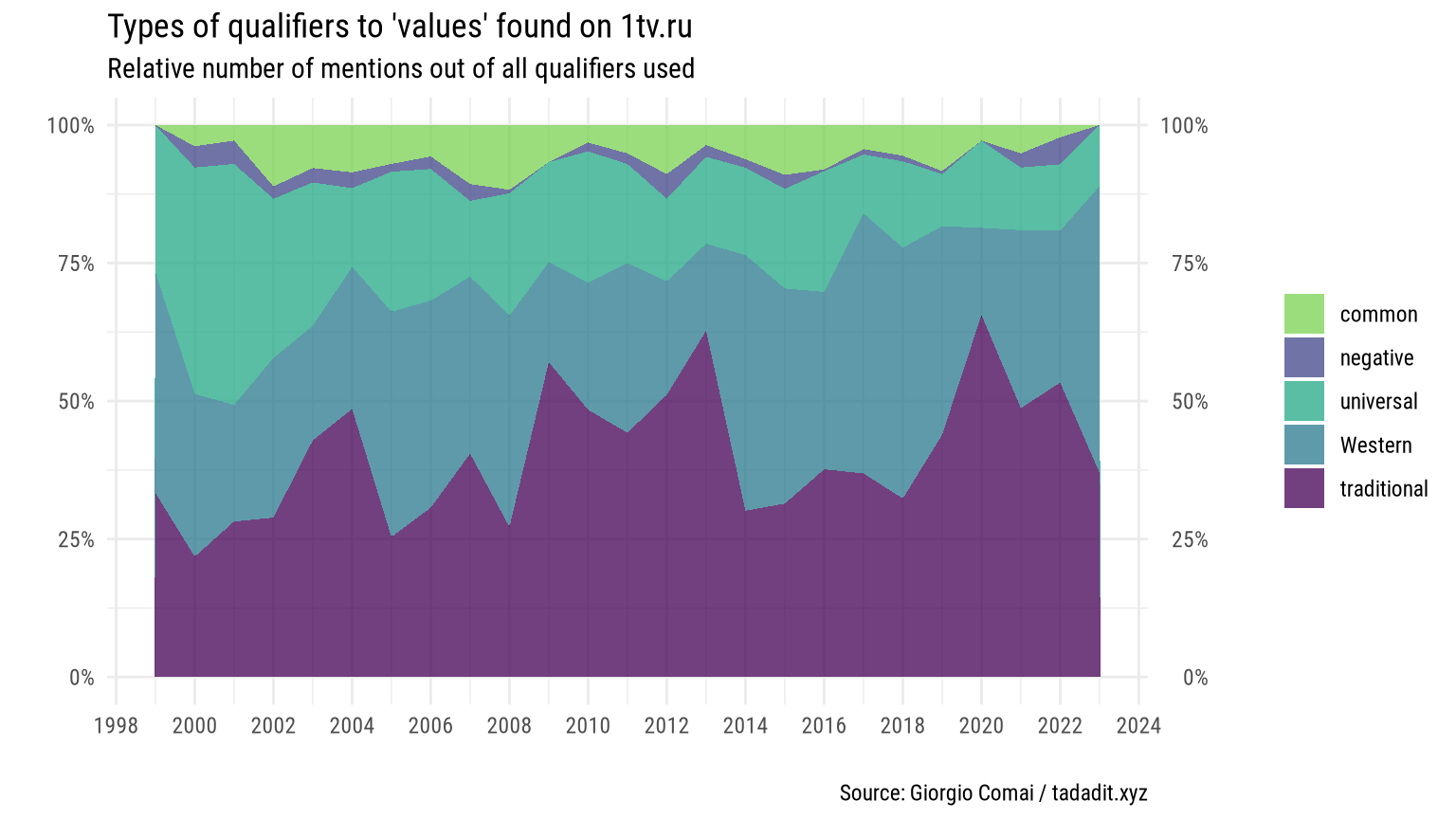
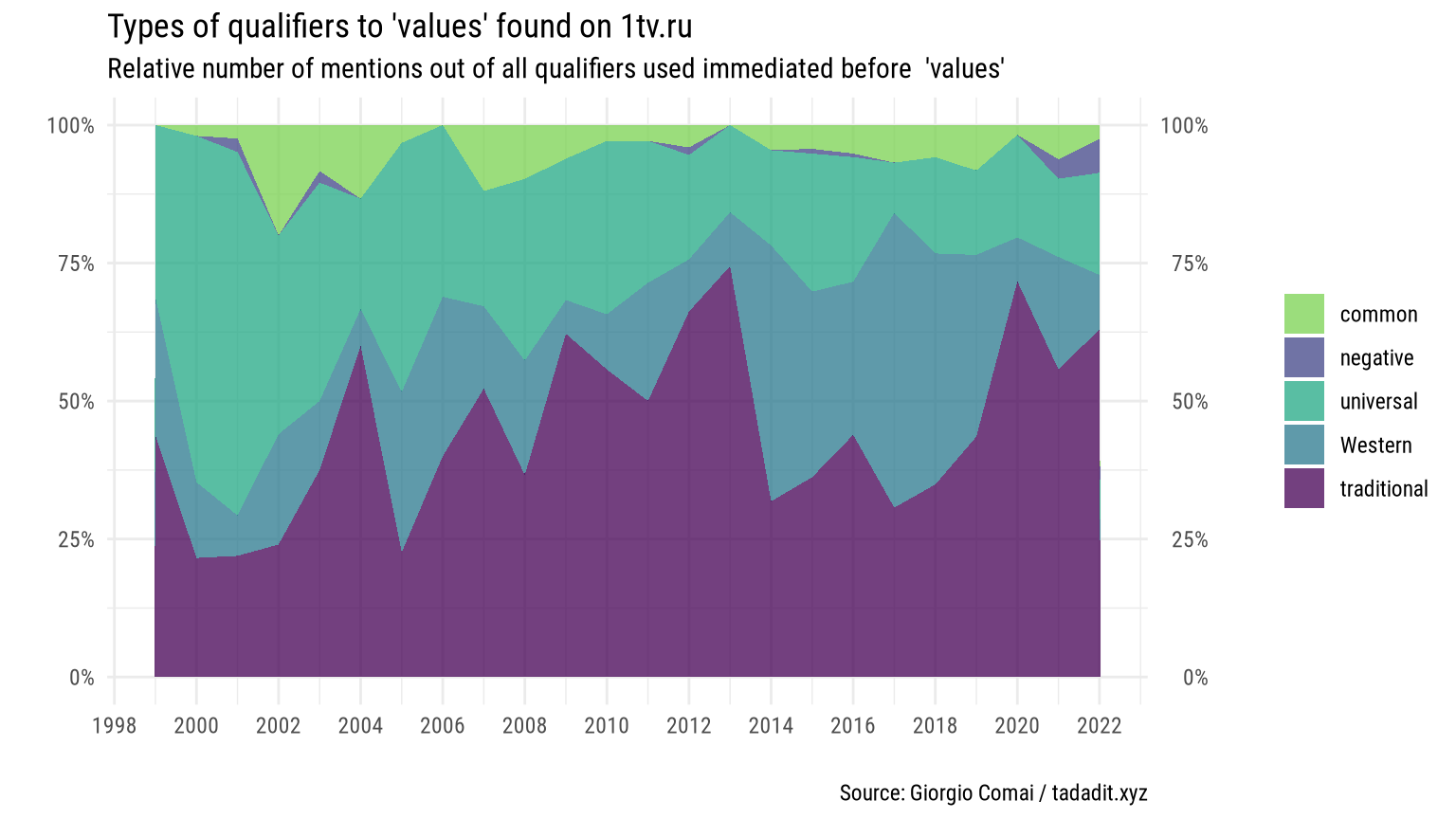
As appears from the the page describing the dataset, a very noticeable change in the format of web publications on 1tv.ru in 2022 makes it difficult to compare data starting with 2022 with earlier periods (in brief, it became common practice to include just a brief summary of news items rather than including full transcripts). There should still be value in the long term analysis, as Pervy Kanal’s website includes news starting from 1998.
Secondly, in Russian it is more difficult to single out references to “values” (“ценности”) in their moral sense, from other references to “value”, such as “the value of something”.
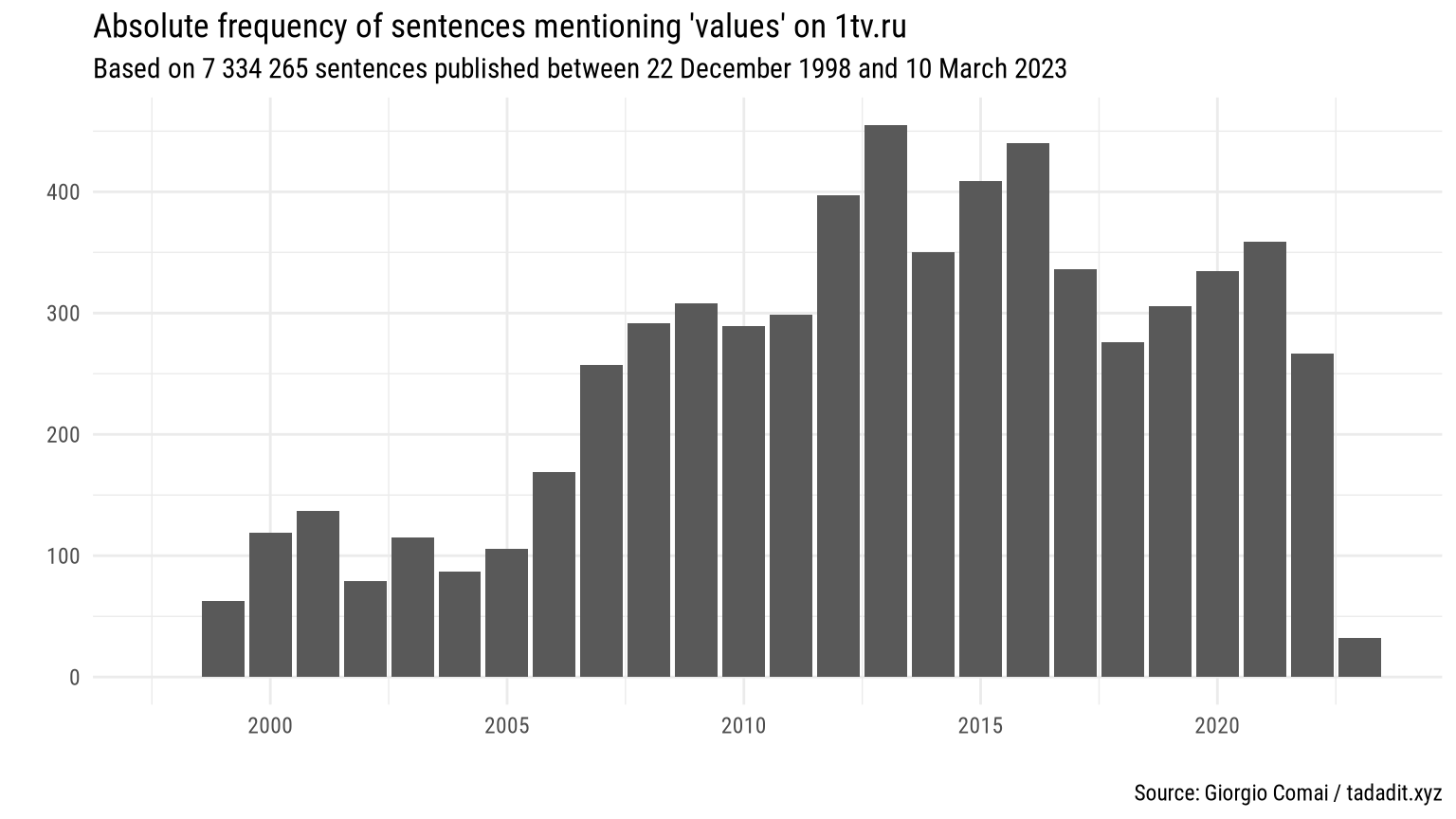
| year | all | with_values | without_values |
|---|---|---|---|
| 1998 | 434 | 0 | 434 |
| 1999 | 79 615 | 63 | 79 552 |
| 2000 | 130 001 | 119 | 129 882 |
| 2001 | 152 488 | 137 | 152 351 |
| 2002 | 127 686 | 79 | 127 607 |
| 2003 | 135 061 | 115 | 134 946 |
| 2004 | 120 577 | 87 | 120 490 |
| 2005 | 146 143 | 106 | 146 037 |
| 2006 | 193 819 | 169 | 193 650 |
| 2007 | 264 106 | 257 | 263 849 |
| 2008 | 336 668 | 292 | 336 376 |
| 2009 | 388 110 | 308 | 387 802 |
| 2010 | 382 989 | 289 | 382 700 |
| 2011 | 425 266 | 299 | 424 967 |
| 2012 | 465 610 | 397 | 465 213 |
| 2013 | 431 217 | 455 | 430 762 |
| 2014 | 465 516 | 350 | 465 166 |
| 2015 | 432 624 | 409 | 432 215 |
| 2016 | 462 492 | 440 | 462 052 |
| 2017 | 421 170 | 336 | 420 834 |
| 2018 | 367 524 | 276 | 367 248 |
| 2019 | 359 233 | 306 | 358 927 |
| 2020 | 396 872 | 335 | 396 537 |
| 2021 | 378 470 | 359 | 378 111 |
| 2022 | 238 480 | 267 | 238 213 |
| 2023 | 32 094 | 32 | 32 062 |
References
Laruelle, Marlene. 2016. Russia as an Anti-Liberal European Civilisation. Edited by Pål Kolstø and Helge Blakkisrud. Edinburgh University Press. https://www.universitypressscholarship.com/view/10.3366/edinburgh/9781474410427.001.0001/upso-9781474410427-chapter-011.
Østbø, Jardar. 2017. “Securitizing “Spiritual-Moral Values” in Russia.” Post-Soviet Affairs 33 (3): 200–216. https://doi.org/10.1080/1060586X.2016.1251023.
President of the Russian Federation. 2015. Strategiya Natsionalnoi Bezopasnosti Rossiiskoi Federatsii. https://rg.ru/documents/2015/12/31/nac-bezopasnost-site-dok.html.
President of the Russian Federation. 2021. Strategiya natsionalnoi bezopasnosti Rossiiskoi Federatsii. http://kremlin.ru/acts/bank/47046.
President of the Russian Federation. 2023. Kontseptsiya Vneshnei Politiki Rossiiskoi Federatsii. https://rg.ru/documents/2023/03/31/prezident-ukaz229-site-dok.html.
Quenoy, Irina du, and Dmitry Dubrovskiy. 2018. Violence and the Defense of “Traditional Values” in the Russian Federation. Edited by Olga Oliker. Center for Strategic; International Studies. https://www.csis.org/analysis/religion-and-violence-russia.
Rodkiewicz, Witold, and Jadwiga Rogoża. 2015. Potemkin Conservatism: An Ideological Tool of the Kremlin. Warsaw. https://www.osw.waw.pl/en/publikacje/point-view/2015-02-03/potemkin-conservatism-ideological-tool-kremlin.
Sharafutdinova, Gulnaz. 2014. “The Pussy Riot Affair and Putin’s Démarche from Sovereign Democracy to Sovereign Morality.” Nationalities Papers 42 (4): 615–21. https://doi.org/10.1080/00905992.2014.917075.
Tsygankov, Andrei. 2016. “Crafting the State-Civilization Vladimir Putin’s Turn to Distinct Values.” Problems of Post-Communism 63 (3): 146–58. https://doi.org/10.1080/10758216.2015.1113884.
Footnotes
It is not easy to remove completely all references to values that actually express a totally different meaning of the word, e.g. when it is used as a verb. To reduce their number, sentences such as “Russia greatly values” or “Russia values” (e.g. “Russia values its reputation as a reliable, proven partner…”), which are the most common such cases, have been removed from the dataset from the outset.↩︎
Excluding all press releases and focusing exclusiely on transcripts does not change significantly the broad trends that emerge from these graphs.↩︎